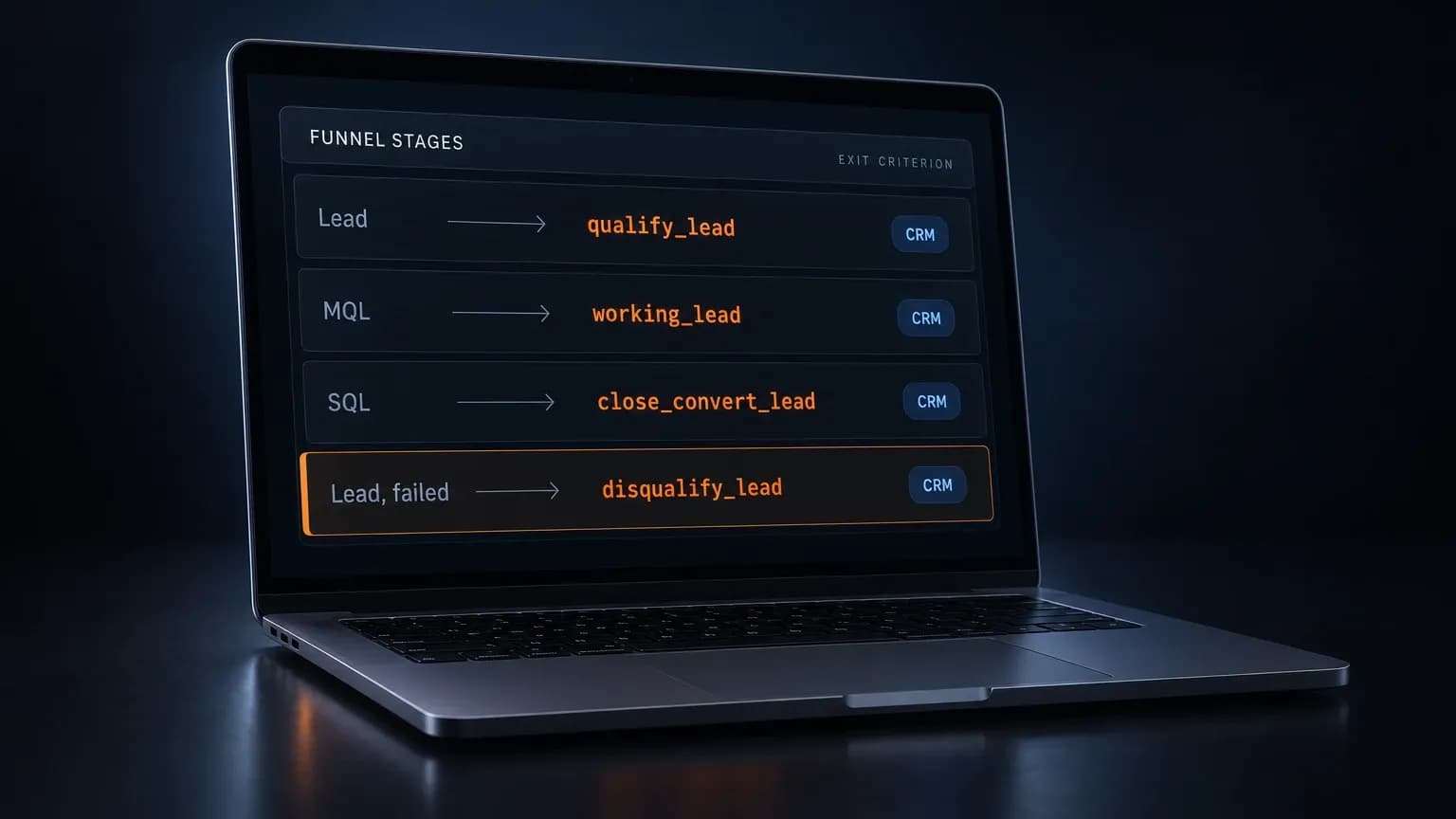
Your funnel diagram has a number nobody in the room chose. It came from a slide, then a template, then a tool default, and it has read as fact since. Can you name the event that closes your second stage, or only the label on the box?
Ask two tools how many marketing funnel stages exist and you get two confident answers and two diagrams. Google's AI Overview answers four primary stages. ChatGPT, same query, same day, answers seven. Below them the organic results argue among themselves, serving three, four, five and six stage models on one page. At least four of those are different versions of four stages. Your funnel matches none of them exactly, and it never did. The count is not a fact about marketing.
The number in your own model was inherited the same way, and it has been load-bearing ever since. Every one of those models leaves out the thing that would make it operational.
Every Page Answering This Query Is Having the Same Argument
The size of the disagreement is the argument. The eighteen organic slots on this query carry readable titles and snippets. Between them they assert three stages, four stages, five stages and six stages in the same sitting. The four-stage group is not one group. AIDA is not the same four as awareness, consideration, conversion and loyalty. That is not the same four as awareness, consideration, decision and advocacy. None of those is the same as top, middle, bottom and loyalty.
Freshness does not settle it either. Three of those results carry 2026 dates, and two of the three are three-stage explainers, so the newest work in the field is spent re-explaining a model rather than improving it.
Now the part that matters more. Six of those pages were captured and read as text rather than summarised from a snippet. The phrase "exit criterion" appears in none of them. The word "exit" does appear seven times across the first batch. Every one of those uses is site-abandonment machinery: a popup shown on leaving, a survey shown on leaving, a share of sessions ending on a page. Not one is about where a stage ends.
Take the claim at the size measured. None of the pages currently answering this query defines what closes a stage, which is narrower than saying nobody ever has.
Two of them come close enough to name. Contentsquare concedes you can simplify to three stages, then adds and renames stages anyway. Sprout Social states that "no single model is universally accepted by all companies", then writes the rest as though one were. Both notice the problem. Neither charges it to anything.
That gap, between noticing that the count is arbitrary and acting on it, is the whole opening. So here is the position this page takes: a stage is real when it has an exit criterion you can instrument. The name is a label. The count is a preference. What makes awareness a stage rather than a heading is that you can point at the event which ends it. And you can name the field where that event is recorded.
A Stage Needs Three Things, and a Name Is Not One of Them
Three conditions, and a stage that fails any of them is a heading with a paragraph under it.
A named event. Not a level of intent, not a score band, not "engaged". An event with a name that a system fires or a person records. qualify_lead is an event. "High intent" is an opinion that has not been written down yet.
A system that records it. The event has to land somewhere durable. Sometimes that is the analytics platform. More often it is the CRM, because a person looking at a pipeline made the decision, not a browser.
A field you can query. An event is a moment. A field lets you ask a question about that moment six months later. Date exited Marketing Qualified Lead is a field. A note in a call log saying the lead looked good is a memory.
Add a fourth test, because it separates a funnel model from a status report: the boundary has to be able to fail. A model in which nothing can go wrong cannot tell you to stop spending.
Run the three conditions against your own funnel. For each stage on the diagram, name the event, the system and the field. The first is usually easy, the second catches people out, and the third is often blank. Those blank stages are producing the reporting you already do not trust.
The Exit Criterion Table for Marketing Funnel Stages
Here is the asset this page exists for. Six conventional stages, the event that closes each one, the system where it lands, and the field that proves it later. Every cell names an identifier you can check in your own account.

Stage | The event that closes it | Where it is recorded | The field that proves it |
|---|---|---|---|
Visitor or anonymous | | GA4 | The event itself, plus |
Lead | | A CRM decision, mirrored into GA4 | The lifecycle change that lands in |
Marketing qualified lead | | CRM to GA4 | |
Sales qualified lead | | CRM to GA4 | |
Opportunity | Closed Won or Closed Lost | CRM | The opportunity |
Customer | Retention or expansion, for which no standard event exists | CRM only | Unsupported, and marked as such: GA4's B2B lead set has no event for this |
Two things about that table are deliberate.
Every row has a failure path, and it is named. disqualify_lead and close_unconvert_lead sit in the same documented set as their positive counterparts. disqualified_lead_reason is a parameter, not a comment somebody leaves. A funnel that only counts advancement is not measuring a boundary, it is counting arrivals. The most expensive thing your funnel does is keep a bad-fit contact moving, and a model with no failing boundary cannot see it.
The last row is unsupported because it is. GA4's B2B lead set stops at conversion. There is no retention event and no expansion event in it, so a customer-stage criterion has to be built in the CRM with fields you define yourself. Writing a plausible event name there would have made the table look complete and the recommendation wrong.
The marketing qualified lead row is where two words often mean one boundary. That distinction is a discipline of its own, set out in demand generation vs lead generation.
Only One of GA4's Six Lead Events Is a Behaviour
GA4 documents six recommended B2B lead events. Its own reference groups them under a note that they suit "business-to-business sales... or generally for when conversions occur offline". Read the trigger wording for each and a structural fact falls out.

generate_lead fires when a user "submits a form online or submits information offline". It is the only one of the six describing something that happens on your site.
The other five describe something happening to a record. qualify_lead fires when a user "is marked as fitting the criteria to become a qualified lead". disqualify_lead and close_unconvert_lead fire when someone "is marked as" not proceeding, for one of several reasons. working_lead fires when a user "contacts or is contacted by a representative". close_convert_lead fires when a user "became a converted lead".
"Is marked as" is a CRM write. It records a decision a person made in a pipeline view, copied into an analytics platform so a report can show it. Nothing is wrong with that, and it is how a funnel that closes offline is supposed to work. But an exit-criterion funnel cannot be built in GA4 alone. GA4 reports decisions made in the CRM. Any guide telling you to build your funnel in your analytics tool is describing half a system, usually the half that was never the constraint.
You Already Own the Exit Field
The exit criterion is not something you have to design. It is something you probably already licence.
HubSpot's lifecycle stage property ships with seven ordered values: Subscriber, Lead, Marketing Qualified Lead, Sales Qualified Lead, Opportunity, Customer and Evangelist, plus an Other bucket. Attached to every one of those is its own set of properties: Date entered [stage], Date exited [stage], Latest time in [stage] and Cumulative time in [stage].
Date exited [stage] is an exit criterion written down as a field. That reframes the claim. It is not "go and build a funnel model". It is "you own the bookkeeping already, and it is probably measuring a stage nobody defined".
Three details decide whether that field tells you the truth.
Automatic movement is forward only. HubSpot documents that default automatic updates "will only move the stage forward". Re-entry is handled elsewhere, which is what Cumulative time in [stage] is documented for: contacts who "re-enter a stage multiple times".
Going backwards rewrites half your history. Move a lifecycle stage backwards and the legacy "Became a [stage] date" property is cleared. The newer calculated properties are not. Two property sets then disagree about what happened, and only one is the one you built the report on.
Two of the four properties cost a tier. Latest time in [stage] and Cumulative time in [stage] require a Professional or Enterprise subscription. The entered and exited dates do not, so on a lower tier you have the boundary and not the duration.
Three Stage Counts and the Business Condition Each One Needs
If the count is a preference, pick one on purpose. Three are in general use, each answering a different business condition.
AIDA, four stages. Awareness, interest, desire, action. This is a message model before it is a database model. It fits a brand-led business where one person decides and the job is category education. Its weakness: desire is not an observable event, so a funnel built on AIDA has three instrumentable stages and one that lives in a creative brief.
The five-stage demand model. Awareness, discovery, consideration, conversion, retention. This fits a business where marketing owns a pipeline number and retention sits in the same report. It earns the extra stage by making retention a marketing boundary rather than a customer success afterthought.
The long product-led model, somewhere around ten stages. Trial, activation, habit, expansion and their neighbours. This fits a business where the product generates the signal and the funnel has to hold behaviour inside the product. Its weakness is the opposite of AIDA's. So many stages are observable that teams instrument all of them and decide nothing.
The Collapse Problem: Your Buyers Re-Enter
Every model above assumes a path. The evidence says the path is a loop, and it says so at the level of the buying group rather than the individual.
Forrester's The State Of Business Buying, 2026, published in January, puts a typical B2B decision at 13 internal stakeholders and nine external influencers. The base was a survey of nearly 18,000 business buyers. Twenty-two people is not a queue. It is a negotiation, which is why one contact's stage tells you so little. The figure sits beside a long-cited range of 6 to 10 decision makers. The credible reading of that gap is a definition difference between decision makers and everyone who influences. Even the size of the buying group is a counting argument.
Then the loop itself. Gartner's six buying jobs are problem identification, solution exploration, requirements building, supplier selection, validation and consensus creation. They are explicitly not sequential, and Gartner's research as reported secondhand puts 95 percent of buying groups revisiting at least one. Set that against a model that only moves forward, and the model is not simplifying your buyers. It is contradicting a published finding about almost all of them.
The product constraint makes it concrete. The dominant mid-market CRM has no native way to move a contact backwards automatically. Re-entry is handled by cumulative-time properties rather than by the stage. That is the collapse problem as a software design decision, checkable in your own account.
Salesforce reaches the same place another way. Its opportunities carry a picklist of default stages, each with a default probability and forecast category. Validation rules can refuse an advance until required fields are filled. The probability that ships with a stage is the vendor's guess, not your rate. Two companies using the same defaults report the same percentage at the same stage name and mean different things. A stage whose probability is inherited is a stage nobody has defined.
Instrumenting It: Six Events, One Setting and Four Reports
The minimum event set is the six GA4 B2B lead events, plus the lifecycle fields on the CRM side. Before any report, one setting decides what your funnel means.
GA4's funnel exploration offers open and closed funnels. Open lets users enter at any step. Closed requires them to start at step one and follow the defined order. A closed funnel under-counts a B2B journey that re-enters. For a business whose buyers loop, that is the most consequential click in the tool.
Given that, four reports do the work.
Time in stage, reported as a median with the tail visible, from the entered and exited dates. The median tells you what normal looks like. The tail is where the contacts nobody has called sit.
Boundary outcomes per stage, split by direction. Advancement and failure counted separately, with failure reasons grouped. A stage whose failure side is climbing has a qualification problem, not a content problem.
Re-entry rate, being contacts whose cumulative time in a stage exceeds what a single visit could account for. This tells you whether open or closed is the honest setting for your business.
Displacement. Contacts sitting in a stage past a threshold you set on purpose, sorted by time in stage. This is the only one of the four that produces a decision on its own, because it produces a list of names.
The reporting philosophy behind those four belongs to marketing measurement. Which numbers earn a permanent place belongs to marketing KPIs. Where a stage ends is a different question from who gets credit for the touch that moved it, which is multi-touch attribution territory.
The Failure Mode: A Model Reported Monthly That Decides Nothing
There is one failure worth designing against, and it is not a wrong stage count. It is a funnel model that appears in a monthly report, gets discussed for four minutes, and never changes a decision. The test is not whether the numbers look reasonable. It is whether you can name a decision the model changed last quarter. If you cannot, it will stay decorative until one of its boundaries is allowed to fail.
The empirical form of the argument is in the MQL data. One 2026 compilation is vendor-adjacent, so read it as a signal rather than a rate. It reports MQL volume down 18 to 23 percent year over year, while MQL to SQL conversion climbed 4 to 6 points. It attributes both to teams tightening their definitions. Read that as a stage doing its job: tighten the boundary and the numbers move.
Conclusion
The count will keep changing, because it was never a fact. What is available to you is smaller and more useful. For each of your marketing funnel stages, name one event, one system, one field, and a failure path that can fire.
I would start with the stage where the third answer is blank, because that is where your reporting is currently confident and unfounded. Then I would check one field name against one real record before believing any of it. Date exited Marketing Qualified Lead is only an exit criterion if somebody has agreed what entering means.
The argument on page one of this query is about how many boxes to draw. Your buyers are not in the boxes. They are in whatever your CRM recorded when they moved, and that is a much shorter list than any diagram suggests.
This is the work my team and I do with clients at Allable, and it rarely starts with a new dashboard. It starts with somebody opening one contact record and reading the date fields out loud.
Frequently Asked Questions
How many stages does a marketing funnel have?
There is no fact of the matter. On one page of results for this query, three, four, five and six stage models are served at once. Google's AI Overview answers four. ChatGPT answered seven the same day. Choose the count your business condition needs, then spend the effort on exit criteria.
What is an exit criterion in a funnel stage?
The named event that closes the stage, the system that records it, and the field that proves it afterwards. `qualify_lead` landing in `Date entered Marketing Qualified Lead` is an exit criterion. "High intent" is a score band with no boundary in it.
Can you build funnel stages in GA4 alone?
No, and the reason is structural rather than a gap in the tool. Of GA4's six documented B2B lead events, only `generate_lead` describes behaviour on your site. The other five record a decision someone made in the CRM.
Is a marketing funnel the same as a lead generation funnel?
No. A lead generation funnel runs from capture to pipeline, and its job is qualification. The conventional marketing funnel runs from a visitor to a customer, and its job is the whole journey. The two share one boundary, the handoff, and that boundary is usually the one with no exit criterion attached.
Why do contacts move backwards through my CRM stages?
Because buying groups loop. Gartner's six buying jobs are not sequential, and its research puts 95 percent of buying groups revisiting at least one. That is why HubSpot documents cumulative time in a stage for contacts who re-enter one. If your model only moves forward, the backward movement still happens and you do not record it.